She Uses Her Space (SUSH): Chapter 3 一 Edge of Her Space | Light Novel

“Limits are only ceilings waiting to be touched.”
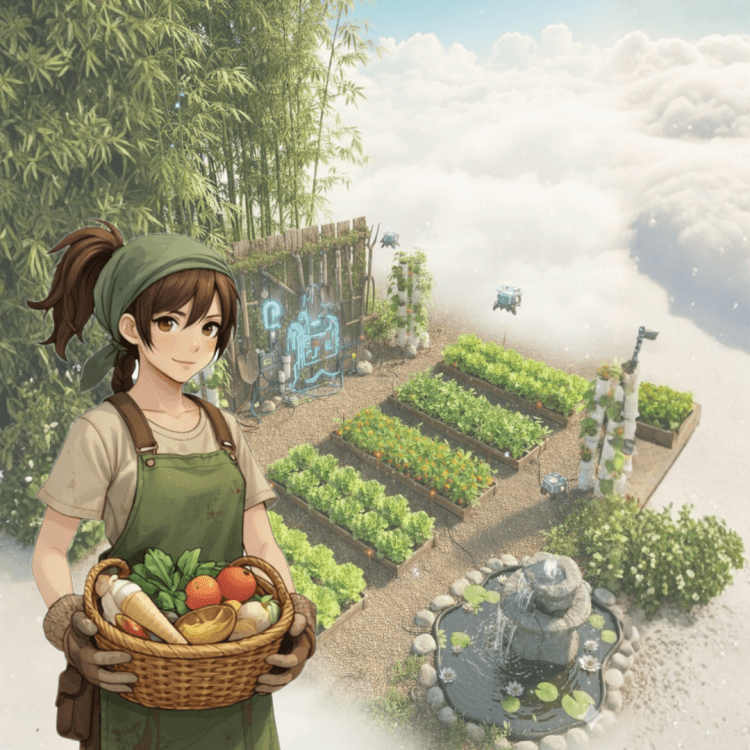
Morning in my SPACE comes in quiet layers—cool air first, then the sound of the fountain ticking against the pond, then the soft scrape of my shoes as I circle the towers. I try to keepthe order the same every time: check log, note down readings, make adjustments. Habits and routines makes sure nothing gets forgotten. I rotate the first tower .
The PVC gives a protesting creak. I press two fingers to the pipe—cool, not clammy. Good. The wicks are next: one looks swollen at the top and starved at the bottom, so I trim the top by the width of my thumbnail and thread the tail deeper with a skewer. The curtain panel I clipped along the rafters—cut from an old liner—gets nudged two finger-widths lower to blunt the noon glare.
PVC Tower Two, an alpine rootling has slumped against the cup lip as if weighed down by burdens of life. I rig a cloth loop so it rests on fabric instead of metal, then tilt the cup so condensation would slid away. I noticed this week that the fountain lip gives better water than the pond surface. It shouldn’t. Water is water.
But I found if I dribble lip-water at the base of the saffron crowns, the leaves stay upright for longer between watering. I tested it yesterday: three cups, three sources—lip, surface, stored jar—no other changes. I did wonder if other SPACERs have experienced something similar. But I don’t ask anyone, not even on the gardening forums. My gut tells me this small secret isn’t so small. So I just file this tidbit away in my mind.
[ Official source: http://www.betwix.co — © JL Chee ]
That is not the only odd thing about my SPACE. No matter how many times I oil it, the door to the shed always opens with a single breathy complaint from the hinge. Today, I clip the stiff spines of two titles as I walk past a shelf. They were sitting forward like naughty student just waiting to trip passer-bys. I pull them out “Humidity for Stubborn Stems” and “Capillaries in Soil: A Short Guide”. Just the things I needed too. Odd. Yes. Am I going to question it now? No.
With a shurg, I tackle the short guide first. It had helpful illustrations that pointed out where I had gone astray. As I was trying my best to absorb the knowlege the alpine sprout in Cup Seven chooses to fold like paper. I caught it before it took a dive.
The condensation path from the pipe above hit this cup more than the others. I punch a pinhole just above the rim to vent the drip and shorten the wick by a thumb’s width. Then I loosen the cloth loop and stroke the stem lightly with the back of a knuckle.
“You’re wilty,” I tell it. “Probably need more air and less abuse from the drip.”
The fountain gurgles. The pond makes tiny concentric nods as if agreeing. When I climb back out into my dorm room, the wall clock blinks 6:54. I check what time I went in—6:02. Fifty-two minutes. My shoulders feel like two hours. I write “Time drift?” in the margin and don’t cross it out this time.
Lessons
In school, the morning smells like chalk and lemon disinfectant and shoes that can’t decide whether to squeak. Master Hu paces in front of the board like he’s trying to wear a groove in the floor that will convince numbers to fall in line. He taps the chalk twice before he speaks. We all breathe in on the second tap now; he’s trained us.
“In half a year,” he says, “you will not be sitting in these desks. You will be trade-tracked. The guilds will look at what you have done with your SPACEs—output ratios, adaptability markers, consistency—and place you accordingly. Repeat it.”
“Output, adaptability, consistency,” the room mutters, a few voices crisp, a few sulking. He writes two examples on the board.
“If one plot of one by two meters yields thirty units in forty labor hours, and a two by two yields forty units in forty-five labor hours, which candidate demonstrates superior labor efficiency per unit, normalized for area?”
I already solved this in my head while he was saying half a year. I keep my eyes on my slate and draw two clean lines: .75 and .88 per meter, then factor area and labor. The smaller plot wins on labor per unit mass if area overhead is counted. My mouth wants to say it. My throat decides it can live a little longer without overseers peering down into a tenant garden that shouldn’t be doing what it’s doing.
Master Hu’s eyes pass over orchard-kids with their neat hair and guild pins their cousins left “by accident” on jackets. Their faces do that thing—relaxed smirks that don’t know they’re smirking. Two rows back, broom-closet boy sits straight with his hands flat on his slate. He has the kind of posture that looks like obedience and is really focused. A guild-bound boy leans in and says just loud enough,
“Better start polishing boots. That’s all your space is good for.” It isn’t clever, so it hits hard. Master Hu doesn’t turn. He is not paid to have ears beyond the equation. He writes consistency on the board in tall letters and underlines it.
Break is noisy in the way of the last year of school—everyone pretending they are still children because no one knows how to act like almost-workers yet. I find the courtyard wall and lean beside the broom-closet boy. He looks at me sideways.
“How many holes did you drill?” he asks, like we’re resuming a conversation we left mid-sentence yesterday.
“Less than that TubeNet lady,” I say. “Her pipes ran like they were late for a train. I made mine walk.” He huffs; the sound wants to be a laugh but refuses to get caught doing it.
“Figures. Mine—” He tilts his head, as if he’s listening to the air inside his own ribs. “I put in a second hook. That’s my version of making water walk.”
“You can fit more in a small room if you stop thinking it’s small,” I say, which is stealing my father’s line and filing the serial number off. He squints.
“Is that yours?”
“It will be if I say it enough.” From the steps, a pack of boys perform loud opinions like they’ve been hired.
“Did you see the Tier Five clip?” one crows. “Cray-cray. Even Quan posted about it like it was real.” He stretches Quan’s name until it becomes a brag about how closely he follows famous people.
“It’s just conspiracy attention seeking,” another says. “You say higher tier worlds using us as a terrarium, you get a million views. Next he’ll sell shirts.”
“Already reserved mine!” a third adds, triumphant. “Glow-in-the-dark.”
They laugh and shove each other like puppies. The word invasion floats over and perches on my shoulder for a second. I let it hop off. In our house, terrariums are jars where my mother starts seeds that refuse to believe in wind yet. That viral clip is entertainment; their noise is entertainment about the entertainment. The part of me that is a student writes ignore on the inside of my skull. The part of me that is a person looks at their faces and sees fear disguised as loud.
Three girls drift over with orchard gloss and mid-tier confidence. Their braid ribbons match. They smell like citrus soap and something expensive that pretends to be flowers.
“Balcony girl,” one says, not looking at me directly, the way you address a stray dog you’re considering feeding. “How’s the parsley?”
“I don’t grow parsley,” I say, pleasantly. “We’re not speaking.” A second girl tilts her head.
“I saw a post about balcony kids buying saffron at the market and posting pictures like they grew them. Sad, right?”
“If I were faking,” I say, “I’d pick something more impressive than parsley.” That startles one of them into a blink. The third’s mouth curves; she appreciates a clean line even when it cuts her friend. The first recovers by doubling down.
“Practice humility,” she says. “It looks good on people who don’t have guild offers.”
“Practice math,” broom-closet boy says mildly. “It looks good on anyone who has to live in the world.”
They leave with the flounce of people who are used to air moving out of their way. On their way past the boys at the steps, one points and grins: “Glow-in-the-dark? You’d buy anything.”
“I would not,” he says, already buying it in his head. Broom-closet boy and I say nothing until the flock’s noise moves to the far end of the courtyard.
“Thank you,” I say.
“For what?”
“For not making it worse.” He shrugs. The tape that holds his hope to his face doesn’t show, but I can hear it when he says,
“Six months is a long time to be sorted.”
“We’re not inventory,” I say, quietly.
“No,” he agrees. “We’re limited edition.” This time I let myself laugh, soft and embarrassing, and then the bell rings and no one admits we were just people two seconds ago.
Trading
After school I do the thing everyone does when they’re trying to grow something expensive inside a room that only just learned how to be a room. I check my forums. TubeNet gardening is the same combination of kindness and weird myth it was last week. One teen writes a panicked post about tomatoes that fainted on a shelf; five older growers answer with dryness ratios and stories about sunburn that sound like fairy tales. One account I trust mentions saffron dry-down rates and heat thresholds. Another says, “Put your bulbs under moonlight and whisper.”
I reply to the first with a question about airflow and string trays and pretend I didn’t see the second. I crop a photo so there’s nothing in the frame except tweezers and three bright threads laid out like punctuation. I start to type: Shade or low heat for dry-down? then delete the question. I don’t want advice to warp what I’m learning. I write it in my logbook instead, which is both boss and confessional: dry-down test: shade v. fountain warm air; track weight after 24h.
A private message pings from the boy who traded me roots for nails. Roof patched, he writes, and sends a picture of a ceiling that is no longer pretending to rain. 2.0 cm wick too dry. Trying 2.2. I type out Try a mesh baffle to slow draw through the pipe and stare at it long enough to feel possessive of something that isn’t mine. I delete it and send only: Nice. Keep notes.
There’s a ripple on the class group chat—someone spams the Tier 5 doc link with seventeen fire emojis. “Quan watched this LIVE,” they write, like that means the world tilted. The chat has enough noise to drown a flood. I set my civic band to quiet. The band buzzes anyway with Mom’s ping, the single polite knock that feels like a tap on the shoulder.
Dinner soon, the ping says without words. I wait three breaths and touch the band. Coming, I reply. Lag. It’s easy to let the lie sit there because our projection was small and ugly, and pity grows faster than weeds in this town. Dad’s reply comes with a smile folded in it: Small SPACEs always lag. Mine used to miss half my pings. Don’t worry. The part of me that is a good daughter feels sorry. The part of me that is building a ladder inside a cupboard folds the pity up and tucks it where it won’t get mud on it.
Family
Dinner is rice and greens and a sliver of pan-fried fish because a neighbor brought my mother “too much” and she pretended to believe him. Dad sets his chopsticks down between bites and watches me with the kind of look that says he is counting the number of times I blink.
“Band lag?” he asks, mild.
“A little.”
“Mm. Mine used to sulk,” he says. “I’d ping my father to say I was almost done, and the band would deliver it after I came out anyway. He thought I was ignoring him. I was—” His mouth tilts—“but the band made a fine shield.” Mom’s face does a whole conversation as she adds soup to my bowl—sympathy, amusement, caution.
“Don’t spend all your hours in there,” she says, meaning: come back even when you aren’t called. “Also, I’ll want the curtain liner back before the weekend.”
“Shade duty ends tomorrow,” I say. “I’ll hem it for you if it frayed.” She nods.
“Useful,” she says, like it is a blessing. We eat. No one mentions the bean jar. No one has to. Families have old conversations that walk into the room on their own even when everyone thinks they’ve shut the door.
Back in my SPACE, evening light fits itself into the corners without complaint. The fountain keeps time like a metronome that only knows one song. I wash my hands at the lip. The small cut along my finger stings, then forgets to. I don’t like it and I don’t dislike it; I take the fact and write it down later where feelings can’t argue with it.
The alpine in Cup Seven has decided to forgive me. Its stem holds the cloth loop like a ribbon, proud of itself for doing what plants do. The saffron sulked for nine days and then opened one flower like a secret being reasonable for once.
Three threads sit on paper on the bench, edges curling as they stiffen. I set a second paper square by the fountain’s warm air path and leave a third in deep shade. The little kitchen scale jerks and pretends not to know weights this small. I write needle: grumpy next to the numbers to make the page less lonely.
[ Official source: http://www.betwix.co — © JL Chee ]
The shed shoves a pamphlet forward with the casual impoliteness of a friend who knows you can’t resist a thin book: “Harvest Schedules for Small Plots” It seems to know where the gaping holes of my knowledge lies and my weakness to quick easy readings.
It’s pamphlet is photocopied and soft at the corners, ink faded to friendly gray. On the first page: “A. Liu, 24, Apprentice “ is written in neat letters. Someone had placed stars next to tips that worked. There are double stars next to a note that says, “Scale what can be proven. Hide what you can’t explain. Live longer.” I’m going to assume the plant lives longer.
“I hear you Mr.Apprentice,” I tell the page, because we are on the same team today. I wedge a strip of mesh inside the second pipe to slow the water. The sound changes—less glug, more hum. I scratch a new line in my logbook.
When I step out, my dorm clock says I’ve been gone forty minutes. My shoulders say an hour and a bit. The band has two messages from the class group chat. One had several glow-in-the-dark jokes and the other thread was from Dad with a picture of a nail laid across a ruler and the caption, “2.1 cm is the legal minimum for nail theft“. I type back:
“Three is the minimum, less is just people misplacing stuff”. He answers with a row of laughing faces.
I want to sleep, but numbers crowd behind my eyes, planting themselves in rows. I open the forum again and see a still of the Tier 5 doc—concentric rings, our tier at the far edge, a narrator’s hands slicing the air. The comments are a storm. A boy has posted:
“Quan wore the shirt! Real ones know.” Under that, someone wrote,
“He can sell you a ladder to the sky and you’d pay extra for the clouds.” Too much fluff. I close the tab.
“If I can’t go wide,” I tell the pillow, “I’ll go up.” The fountain inside my head ticks through the night. Not a lullaby. A metronome. In the morning I’ll know whether warm air dries threads better than shade. In six months the guilds will try to slot me where girls with balcony SPACEs go. In between, there is room for one eighth-turn, one wick width, one careful ratio at a time.
And though I won’t write it yet, because even ink can trip a person—there is the feeling that the soil is speaking back to me. That the water at the lip carries a small willingness that the surface does not. Everything is not what it seems.
==end of chapter 3==
#Action, #Adventure, #AlternateWorlds, #ComingOfAge, #CozyFantasy, #Fantasy, #FemaleProtagonist, #HiddenPower, #Josei, #LightNovel, #ProgressionFantasy, #SciFi, #SUSH, #SliceOfLife, #SliceOfLifeFantasy, #SlowBurn, #WeakToStrong, #WebNovel
Discover more from BETWIX & Co.
Subscribe to get the latest posts sent to your email.
Tags: Action, Adventure, alternate worlds, coming of age, Cozy Fantasy, Fantasy, female protagonist, Hidden Power, Josei, light novel, progression fantasy, Sci Fi, slice of life, Slice Of Life Fantasy, slow burn, SUSH, weak to strong, Web Novel
Leave a Reply