She Uses Her Space (SUSH): Chapter 4 一 Seeds of Change | Light Novel

The shortest road is the one you do not see.
The shed stretched longer than I remembered. Shelves leaned like crooked teeth, their rows narrowing into goat trails of shadow. Between two sagging book spines, the air shimmered—not like sunlight, but like a curtain pulled thin. For an instant I saw shapes beyond: a coastline where the sea glowed copper, a tower scraping a violet sky. Then the shimmer collapsed, leaving only dust and wood.
Sprout rustled at my ankle, leaves trembling toward the shimmer. Ink froze, paws pressed to the shelf, whiskers stiff with warning. A slim journal slipped loose. Its pages were blank—except for a single line scrawled across the center:
“The shortest road is the one you do not see.”
My pulse jumped. I shoved the journal back, but my hand knocked against a small jar half-hidden in shadow. Its glass was cloudy, the lid sealed with wax. Across the front, cramped letters crawled like a dare:
“Eat me and gain clarity. Beware the price you pay.”
I almost laughed—it was the sort of warning kids scribbled into ghost stories. And yet my hand twisted the lid before I could stop myself. Inside lay a shard of golden crystallized ginger. I touched it to my tongue and the world detonated. Agony knifed through my skull. Voices shrieked and folded into symbols, foreign alphabets I shouldn’t have known, equations curling and unspooling like living snakes. My knees buckled. I crashed into the shelf, sending a scatter of books tumbling onto me in a dusty avalanche.
I writhed on the floor, clutching my head. Ink darted in frantic circles, squeaking sharp as needles. For the first time, I felt meaning in the sound: hide it, hide it, hide it. Sprout pressed against my arm, leaves trembling as though to steady me. Its hum pulsed low in my bones: wait, steady, breathe. It hurt! Saints, did it ever hurt! My vision blurred, every blink a fresh blade of light. Words I didn’t know burned into my mind—snatches of speech in dialects I’d never studied, glyphs collapsing into sudden meaning before dissolving again. My body arched, then curled, muscles jerking like wires drawn too tight.
Finally, the tide receded, leaving me gasping, sweat-soaked, sprawled among fallen books. My fingers twitched. The jar lay nearby, empty. Its label blurred, then cleared into my own language: Clarity. Weak, trembling, I dragged myself to the fountain. I scooped water with trembling hands and splashed water on my face. I gulped down several handfuls of the icy water. Coolness spread down my throat, easing the throb in my skull. Not gone—but less savage. I slumped against the wall, chest heaving. The pain ebbed to a dull roar, but the aftertaste lingered—like ink on my tongue, like words crowding at the edge of thought that I couldn’t quite catch. I pressed my palms into my eyes until sparks danced. When they faded, the world looked the same… yet I didn’t. I couldn’t name what had shifted. Only that something had.
Ink nosed the jar farther into the shadows, Sprout curling a leaf protectively over my knee. I stacked the fallen books back onto the shelves with shaking hands and whispered, “Don’t tell anyone.” The fountain burbled in reply.
Family Farm
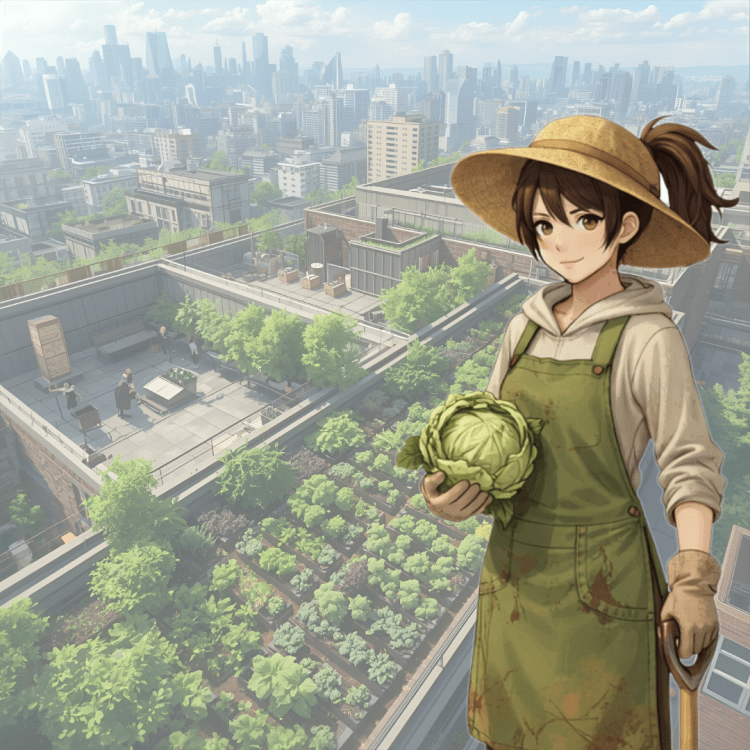
The rooftop allotment smelled of damp soil and oil from Dad’s toolkit. Rows of seedling trays stretched under netting, their leaves neat and uniform, green as soldiers at inspection. The rooftop wasn’t ours alone. Like every family in the block, we leased the plot from the district’s Agri-Bureau. The government parceled rooftops the way other people rented apartments—square footage measured, regulations posted on peeling signs by the stairwell. No one called them gardens; they were urban allotments, just another ledger entry in the city’s food grid.
Ours ran ten meters by twenty, long and narrow, bound by mesh netting to mark the edges. Neighbor rows pressed close, their seedlings separated from ours by a strip of tarp and a shared irrigation spine. The bureau’s pipes fed each block in measured cycles—too strong and the trays drowned, too weak and yields dropped. Dad always grumbled that the regulators cared more about water data than about families.
Still, rooftop space was better than nothing. The riverside allotments—broad terraces along the canals, blessed with mist and rich soil—had been claimed by guilds generations ago. No working family could afford their rents, not when guild contracts turned one terrace into a small empire. Rooftops were cheaper, less fertile, less glamorous. But they kept us afloat. And if you were clever—if your machines ran sharper, or your seedlings rooted deeper—you could make your narrow strip sing.
[ Official source: http://www.betwix.co — © JL Chee ]
Mom bent low over one row, fingers quick and practiced, while Dad crouched beside the water rig, tightening a pipe joint with a wrench he’d filed down himself. Official source: betwix.co/litenovel — © JL Chee
“These trays aren’t glamorous,” Mom said, checking a root plug with her thumb. “But every one of them will transplant clean. Farmers don’t buy dreams—they buy survival rates.” The rig wheezed and then coughed a steady spray across the trays. Dad grunted with satisfaction, tapping the pipe.
“Survival rates go up when the water listens,” he muttered. I carried a tray closer to the spray line and set it down. Rows of basil seedlings shivered, their roots snug in soil Dad had sifted through one of his machines. Neighbors leased his contraptions—soil sifters, tray stackers, pump rigs—because they worked too well to ignore. “Daichi rigs,” people called them, with a laugh that meant respect.
I hesitated, fingers brushing the corner of a crate covered with netting. Beneath it sat my own tray: young Lacelife sprouts, their thick aloe-like leaves catching the spray. Most families grew rough Lacelife on window sills—its gel good for fevers, burns, or infections. But what I gambled on wasn’t just the gel. I was coaxing them for threads.
Fine, fragile filaments that bloomed only under perfect conditions. Ordinary families harvested a few threads a year, weak but useful. High-grade threads, though—ones that could knit wounds or regrow skin—sold for prices that made whole households dream. Some whispered legends of threads strong enough to heal organs. Folklore, maybe. But even low-grade threads brought coin. And mine looked… promising.
“Mom,” I blurted before I lost courage, “I’ve been trying rarer ones. The Lacelife threads. They’re strong for me. I think they’ll sell.” Her hands paused over the soil. She didn’t snap, didn’t scoff—she weighed.
“Finicky doesn’t pay rent, Lara. Neighbors buy what they trust, not what looks pretty.”
“But trust can be built,” I pressed. “One order at a time. Let me take the risk.” Dad looked up from the pump, one eyebrow raised.
“Plants don’t care about promises. They live or they don’t. If hers live… maybe that’s worth noting.”
“Daichi, don’t encourage her,” Mom warned, frowning at him. “One tray is one thing. A whole batch? That’s gambling with our name.” He shrugged.
“Then keep her tray separate. Call it a side experiment. If it fails, no harm done.” Mom’s eyes narrowed, thoughtful.
“Our name is small, Lara, but it’s steady. That steadiness feeds us. Don’t trade it for sparks that burn out.”
“Some sparks catch fires too,” I murmured. For a long moment, only the drip of the water rig filled the silence. Then Mom sighed. Not defeat, but calculation.
“All right. Keep them separate. Don’t touch the brand that keeps this roof over us. But if you’re going to do it—do it like a professional. Clean trays. Clear records. Honest listings. Buyers forgive high prices faster than they forgive lies.” Relief mixed with the thrill racing through me. Permission. Pressure. Both at once.
“Yes, Mom.” I adjusted the shade cloth over my tray, fingers brushing the fragile Lacelife sprouts. Their leaves caught the light as if testing it, hungry but cautious. “Some plants like shade,” I whispered. “So do I.”
Dad snorted softly, tightening one last bolt. “At least she didn’t ask for a new machine.”
“Yet,” I shot back, grinning and ran off to fetch another tray.
A Mother’s Worry
Hana pinched soil between her fingers, rolling it the way she had since she was a girl. Dry soil crumbled. Good soil clung. Today’s batch clung just enough. Daichi had tinkered the grit out of it again, too proud to say he’d stayed up half the night adjusting the rig.
She glanced at Lara, bent over her own tray with a look that was too sharp for her age. Lacelife threads, the girl said, as if words could change odds. Hana had seen whole seasons of crops fail from one early frost. Dreams never survived the monsoon.
[ Official source: http://www.betwix.co — © JL Chee ]
And yet—her daughter’s seedlings did look alive, stubborn in their tiny green way. The girl’s hands were careful, her eyes exact. Hana recognized that fire. She had carried the same spark once, before water bills and allotment leases had pressed it smaller.
“Margins, hm?” she’d told Lara. It wasn’t wrong. Margins kept rice in the pot. But when Lara whispered to her plants, touching them as if they would answer, Hana felt a tug she didn’t admit aloud. Maybe the girl saw something she no longer dared to. She sighed, dusting soil from her palms. Instead she said,
“Keep them separate, Lara. Keep them clean. If you’re going to risk it, at least minimize the risk.”
While the family worked, the rooftop rattled with voices. Four neighbors finished tidying their allotments and clustered at the stairwell, baskets swinging, their chatter rising like birdsong over the netting. Mrs. Han clicked her tongue.
“Barley’s up again. I told my nephew to hoard last season’s harvest. He laughed. Who’s laughing now?” Mr. Osei hefted his basket.
“Until mold gets it. Coin rots slower than grain. Credits? Worse. One server hiccups and—poof—your savings vanish.” Auntie Wen snorted.
“Coin, grain—either way, roofs still leak. They call this a Space Dynasty, all districts unified, one big shining banner. Feels more like the same old monsoon under a different name.” Uncle Jo chuckled.
“Come now, at least we get concerts from orbit. Leaky roof, yes, but free livestream! My niece says it’s ‘historic.’” Mrs. Han shook her head.
“Historic? Hmph. She wasn’t born when we were still Province Four under the old flag. Now it’s just District 14-North. They scrubbed the name off the maps, but we remember.” Mr. Osei raised an eyebrow.
“You mean before unification? My brother moved down to the delta—District 7 now. Used to be called Ghana, long ago. He still calls it that. Neighbors down there roll their eyes.” Auntie Wen leaned on the rail.
“Names matter. Wipe them away and what’s left? A list of numbers. We used to say Kaohsiung, now it’s 14-South. What child will know where their grandmother was born?” Uncle Jo snorted, but his voice was softer.
“Children don’t care for maps. They care for food. As long as rice comes, call the land what you will.” Mrs. Han muttered,
“Unless the guilds price even rice out of reach. Then what?” Mr. Osei gave a bitter laugh.
“Then we all move to the Moon! District Zero, they’ll call it.” Their laughter rippled, but the complaints kept tumbling, voices weaving old names with new numbers, memories with cynicism. Then the stairwell swallowed their chatter, the echoes still arguing whether coin or credit was safer under a mattress.
That night, back in my SPACE, I opened my logbook. Lacelife sprouts tested. Higher margins possible. Risk: medium. Ink scurried across the page, leaving a smear of black that twisted margin into warning. Sprout shifted near my tower, its leaves brushing my ankle like a quiet nudge forward.
I lingered, sorting my notes, then flipping through one of the manuals I’d “found.” Time slipped easily here, too easily. The candle stub I’d lit barely melted, yet I could swear I’d read through thirty pages.
When I finally stepped out, the rooftop should have been dark. I was certain the sun had already dropped behind the high-rises; I’d timed it in my head, even planned to catch the last streaks of orange with Mom. But when I emerged, the horizon was still burning gold, the sun balanced halfway down. My stomach flipped. Inside, it had felt like more than an hour. Outside, barely half and hour had passed.
Watches didn’t help—mine ticked faithfully while I was inside, but when I compared it against the rooftop clock, it was always a little off, as though the gears had argued with the world. Time edged, stretched. Just enough to notice. Just enough to whisper: different.
Our family lived on reliability, on crops that grew when they should. But in my SPACE, nothing obeyed the clock. Not seedlings. Not even time.
==end of chapter 4==
#Action, #Adventure, #AlternateWorlds, #ComingOfAge, #CozyFantasy, #Fantasy, #FemaleProtagonist, #HiddenPower, #Josei, #LightNovel, #ProgressionFantasy, #SciFi, #SUSH, #SliceOfLife, #SliceOfLifeFantasy, #SlowBurn, #WeakToStrong, #WebNovel
Discover more from BETWIX & Co.
Subscribe to get the latest posts sent to your email.
Tags: Action, Adventure, alternate worlds, coming of age, Cozy Fantasy, Fantasy, female protagonist, Hidden Power, Josei, light novel, progression fantasy, Sci Fi, slice of life, Slice Of Life Fantasy, slow burn, SUSH, weak to strong, Web Novel
Leave a Reply