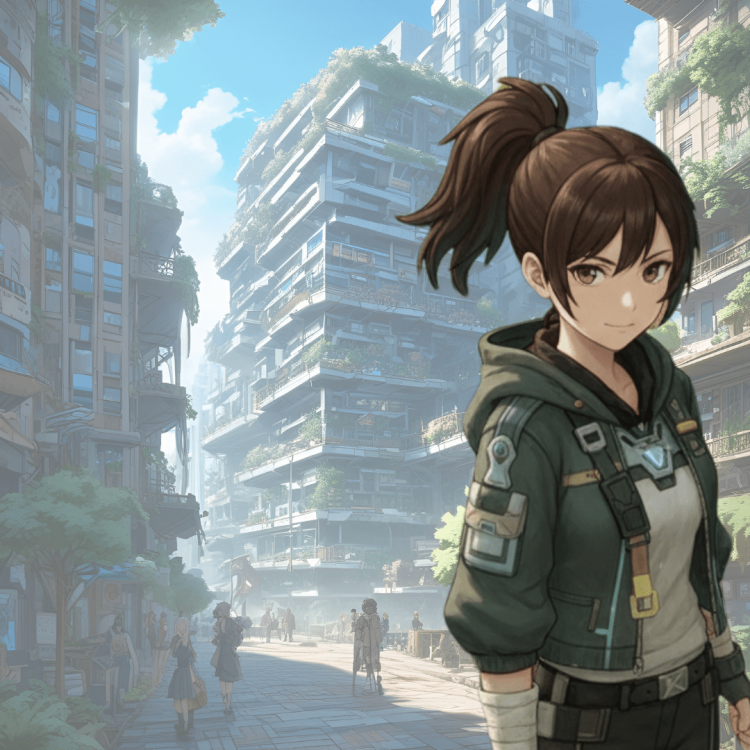
SHE USES HER SPACE (SUSH): Chapter 1 – The Line | Light Novel

Advertisements
Lara’s SPACE is small, but the secrets it hides will change everything.
The line moved in fits and starts, like a tired snake too stubborn to coil. Dust danced in the shafts of sunlight slanting down from the assessment hall’s tall windows. I kept my paper slip pinched between two fingers, as though if I let go, my turn would vanish along with it.
Number thirty-seven.
There were still eleven people ahead of me. Each one stared fixedly at the archway at the end of the hall—the door that led into the viewing chamber. On the other side, their internal SPACEs were projected for everyone to see. It was supposed to be an impartial measurement of potential, but everyone knew it was more than that. The clerks with their clipboards were making notes.
The mangers in the mezzanie were watching with sharp eyes. One day, those observations could determine whether you were chosen for an apprenticeship, a post, or dismissed as ordinary. My civic band buzzed faintly against my wrist, logging me as present. No one slipped through uncounted.
A girl stood just ahead of me. Her hair was coiled high and gleamed like varnished wood in the sun. She didn’t speak, but the corners of her mouth tilted with the kind of confidence that didn’t need words. The rumor about her had reached even my ears: an orchard, heavy with peach blossoms, nested inside her SPACE. Some said she’d cultivated a flock of birds that sang in harmony.
I didn’t know how much of that was true, but I could see how she carried herself as if the world had already confirmed her worth. I adjusted my grip on my slip. My palms were slick. My SPACE wasn’t an orchard. It wasn’t even a grove. The staff’s voice rang out from the front of the hall:
“Number twenty-five.”
A boy shuffled forward. The line contracted again. The floorboards creaked with the weight of so many restless feet. Someone behind me muttered something under their breath—too faint to catch—but a ripple of laughter followed, and I knew they were sharing rumors, placing bets. Who would reveal something grand, who would disappoint.
By the nature of things, every awakened SPACE began with at least a single square foot—the smallest allotment, enough to prove you weren’t hollow inside. The clerks called those “cupboards.” Unusual, yes, but not unheard of. On the world’s average, most children opened with five or more square feet: a pantry, a workbench corner, a garden patch no larger than a cot.
Orchards, fields, rivers? Those belonged to prodigies and guild scions. Anything over a hundred square feet at awakening was rare enough to make the Agri Bureau supervisors lean forward, quills scratching furiously on their slates.
I bowed my head and tried to steady my breathing. It wasn’t the clerks that frightened me, nor even the supervisors. What unsettled me most was the thought of my SPACE displayed like a lantern-show for all to see. Every detail projected. Every shortcoming. I tried not to think of that, but of course I did. And once I thought of it, memory came unbidden.
The first time I stepped into my SPACE, I had been sitting at my desk in the dormitory, drowsy after lessons. A faint ringing had filled my ears, like wind in a bottle. My pen rolled off the desk, and when I bent to grab it, the floor tilted away from me. I stumbled—and the air changed.
Instead of the dusty dormitory, I was kneeling on soil. The scent of fresh earth filled my nose, damp and rich. When I looked up, I found myself in a garden space no larger than my bedroom. Neatly bordered vegetable beds lined one side. Wild flowers and unkempt grass grew over the unused beds. A grove of dense bamboo huddled together against the far side of the plot. Above it all stretched a hazy white lid, as though clouds had been plastered across the sky. Even then, I knew my world had a ceiling.
In the corner stood a shed. Its wooden planks were painted in a color that might once have been blue. The roof slanted to one side, and the door sagged on its hinges, but it opened when I touched it. Beside it, a fountain bubbled gently, water spilling into a round pond barely wide enough for two koi. The sound was quiet and soothing, a steady trickle that made the SPACE feel alive.
It wasn’t much. I had overheard the boasts of others—training fields, orchards, even entire halls large enough to hold banquets. Compared to that, my garden felt like the cramped courtyard of a tenant house, something small and homely.
But then I stepped into the shed. Rows of shelves stretched before me, far more than the space should have allowed. Books lined every surface—manuals about soil and harvests, journals with cracked leather bindings, thick atlases, slim novels. Their spines gleamed, some with titles I recognized, many I didn’t. And tucked between their pages were photographs.
Not the stiff portraits pinned to city registers, but images that pulsed faintly, their colors too vivid to be ordinary ink. A girl smiling beneath a pair of moons. A coastline where the sea gleamed copper under a violet sky. A forest with trees so tall they vanished into mist.
When I touched one, the air rippled like a disturbed pond. For the briefest moment, I felt the pull of another world—its wind brushing against my cheek, its light in my eyes. I had snatched my hand back, heart thundering. That was when I realized: my garden might not be grand, but it held secrets.
The clerk’s voice brought me back.
“Number thirty-six.”
The orchard girl’s head lifted. She glided forward, her braid swaying like a pendulum. I was next. I pressed my slip flat against my tunic, trying to iron the sweat away. My mouth was dry. Behind me, someone whispered,
“Finally,” as though my nervousness was a nuisance to the line. I heard another voice—low, impatient.
“Hurry up. Some of us have places to be.”
I didn’t turn around. My knees trembled, but I forced myself to lock them straight. Above us, the supervisors shifted. I felt their gaze, heavy as the sun. The shed flickered in my mind again, waiting. The trickle of the fountain. The faint glow of photographs tucked between forgotten pages.
“It’s just a garden,” I whispered to myself. My voice was nearly soundless, but the words gave me something to hold onto. But in truth, I wasn’t certain. The staff called out:
“Number thirty-seven.”
My name followed, echoing against the rafters. The hall fell quieter. The orchard girl was already inside; her turn had begun. I moved. One step, then another. The wooden floor creaked beneath my boots. The archway loomed before me, carved with symbols I couldn’t read. Light spilled through it in a thin, unwavering sheet. Once I crossed, there would be no hiding.
I clutched my slip until it crumpled. Everyone would see. Would they see only a cramped garden? A patch of soil and a leaning shed, too small to boast about? Or would they glimpse what I had seen—the endless shelves, the impossible books, the photographs that opened onto other skies?
My throat tightened. One step more, and I stood before the arch. The light hummed faintly, a vibration in my bones. I breathed in. Earth and ink. Water and paper. And then I stepped through. The light swallowed me whole. For a heartbeat, I couldn’t breathe. The chamber inside the arch was larger than I expected—round, with stone walls that hummed faintly, their carvings glowing like molten lines.
High above, an opening in the ceiling let in pale daylight. Around the edges, clerks scribbled notes at tall desks. The supervisors leaned forward from their perch, faces intent, shadows cutting across their sharp features.
“Candidate thirty-seven,” the head clerk intoned. “Commence projection.”
I felt the tug then—like a thread fastened to my chest, pulling outward. My skin prickled as warmth surged through me. The air shivered, and suddenly my garden appeared before us. It unfolded like a painted screen: the dark fertile soil, the tighly packed rows of vegetable beds , the fountain spilling into the small pond. The audience murmured. I heard someone cough softly, another sigh as though disappointed already.
And then my eyes darted to the corner of my SPACE. The shed. Except it wasn’t there.
Where the sagging blue door and weathered planks should have stood, there was only a flat wooden rack, hung with rusted gardening tools. A hoe, a spade, a dented watering can. The supervisors’ eyes lingered on it only briefly before moving on, unimpressed.
I froze. No… no, that’s not right. My pulse hammered in my throat. They should see the shelves, the books. Why couldn’t they see it?
I clenched my fists. To me, the shed had always been the heart of my SPACE—the quiet place with its endless library, its glowing photographs, its impossible promise of other skies. But here, in front of everyone, it looked like nothing but a collection of broken tools. The clerk made a note on his slate.
“Projection confirmed.
Size: minimal.
Fertility: above-average.
Water source: present.
Auxiliary structures: none.
Output ratio: sufficient for tenant plot.”
“No structures?” The word scraped my tongue, though I bit it back before it escaped. To them, I was just another girl with a cramped tenant garden.
The murmurs rose again, a tide of polite dismissal.
“…small…”
“…nothing unusual…”
“…at least the soil looks rich.”
I lowered my eyes, heat stinging behind them. But inside, a new question had already rooted itself, stubborn and alive. Why didn’t they see the shed?
It was strange, standing there while my life was summarized in neat lines of chalk. We all had SPACEs; everyone in the world awakened to theirs by adolescence. Some bloomed early, others late, but by sixteen, even the weakest child had found a door into themselves.
Most were small, like mine—a cupboard, a hollow nook, a corner no bigger than a pantry. Others were grander: orchards, markets, even rivers. They said it reflected strength, potential, the weight of your spirit. A person’s worth was measured not just by what they did with their SPACE, but by how large it might one day become.
[ Official source: http://www.betwix.co — © JL Chee ]
Spaces can grow with you, my grandmother used to say, her voice as soft as the fire’s crackle. Like saplings, they stretch toward light when you nurture them. Ignore them, and they stay stunted. But pour yourself into them, and they may surprise you.
She had always told me the old stories—folktales passed down in her village, from before unification, when people still thought SPACEs were blessings from river spirits or mountain gods. One was about a fisherman whose SPACE had been no more than a puddle. The villagers mocked him, but he spent years tending that little water, dropping in pebbles, whispering his prayers. One spring, the puddle swelled into a lake, and from it he drew fish enough to feed ten villages.
I used to laugh at the tale, thinking it childish. But now, standing in the glow of my own projection, with only my garden bare for all to see, I clung to the memory like a lifeline. SPACEs could change. That much, I believed. And mine… mine already held something it refused to show the world. The shed. The head clerk tapped his chalk against the slate.
“Candidate thirty-seven, you may step down.”
The garden flickered once, then dissolved like smoke. The stone chamber was bare again, leaving me small before the scrutiny. Their eyes had already shifted away, their attention caught by the next name being called.
I pressed my lips together and forced my feet to move. On the surface, I was just another disappointment—just another tenant garden destined to grow a few vegetables, maybe sell herbs in a market stall one day. That was the story the clerks would write down, the supervisors would file away, the Bureau would forget. But I knew better. I had a shed. And what the Bureau couldn’t measure, it couldn’t control.
==end of chapter 1==
#Action, #Adventure, #AlternateWorlds, #ComingOfAge, #CozyFantasy, #Fantasy, #FemaleProtagonist, #HiddenPower, #Josei, #LightNovel, #ProgressionFantasy, #SciFi, #SUSH, #SliceOfLife, #SliceOfLifeFantasy, #SlowBurn, #WeakToStrong, #WebNovel
Discover more from BETWIX & Co.
Subscribe to get the latest posts sent to your email.
Tags: Action, Adventure, alternate worlds, coming of age, Cozy Fantasy, Fantasy, female protagonist, Hidden Power, Josei, light novel, progression fantasy, Sci Fi, slice of life, Slice Of Life Fantasy, slow burn, SUSH, weak to strong, Web Novel
Leave a Reply