She Uses Her Space (SUSH): Chapter 2 — Dinner Banter | Light Novel

Advertisements
Every family meal is a reminder: survival isn’t just food
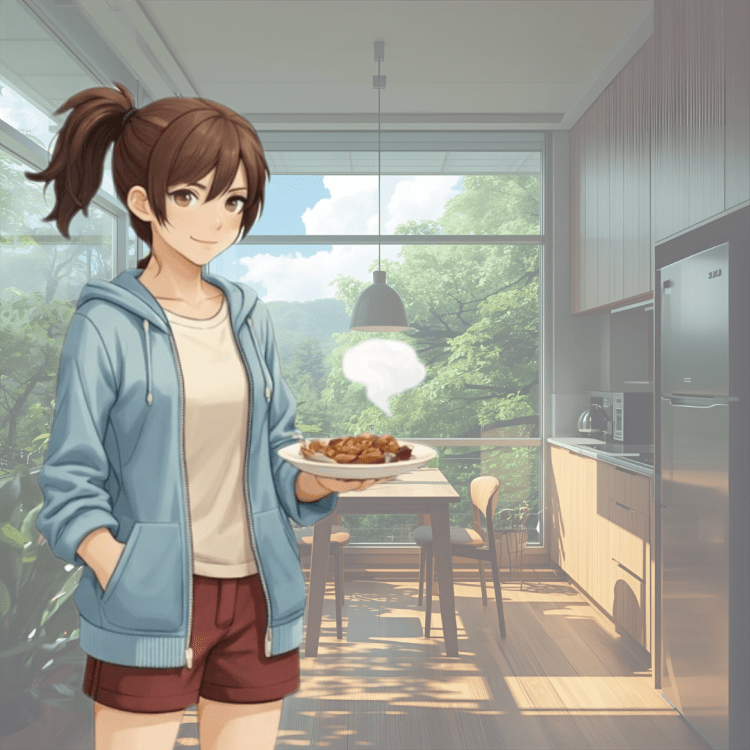
At home, Lara’s family shares a simple dinner. Her father tinkers, her mother tends the fields, and neighbors tease her “balcony SPACE.” Outwardly, she laughs along. Inwardly, Lara begins to wonder: if her SPACE can’t stretch wide, maybe it can grow in a different direction.
I used to lie awake in the dormitory and count the days until my sixteenth birthday, certain I’d be one of the unlucky ones. Doorless.
Doorless meant never opening a SPACE at all. No inner room to tend, no soil, no water, no corner of the self that could grow. Doorless adults lived in the shadows of everyone else—sweeping floors, hauling loads, doing what no guild would claim. It wasn’t a curse, but people spoke their names with pity braided through. The Bureau’s registries logged every awakening, every measurement. And every so often, a name remained blank. Those names whispered down streets heavier than curses.
When my door finally opened, relief swallowed me whole. I cried into the dirt that first night, not caring that the soil stuck to my face. My SPACE was small, but it was mine. Now, weeks later, the relief still hummed in me, though shame tangled with it after the testing hall. They had seen only a cramped tenant’s plot and a rack of rusting tools. They hadn’t seen the shed.
At home, my mother’s Farming SPACE spread wide enough for respect. A mid-sized plot, lined with fruit trees, herbs, and steady rows of staples. On festival days she brought out mint and citrus peel, steeped tea that made neighbors sigh as though luck itself had been poured in their cups. Her SPACE tested steady in the Bureau charts: fertility above district average, Output Ratios consistent enough to earn small guild contracts. Reliable. Predictable. Safe.
I had hoped for something like that. Instead, I had gotten a cramped courtyard, barely ten feet square. Four soil beds squeezed shoulder to shoulder. A fountain pond that claimed the middle like a bossy landlord. And the leaning shed in the corner, peeling blue paint, sagging door. Everything fit, but just barely. No wonder the overseers had written me off.
Dinner was soup, steam curling against the low rafters. Dad sat at the table with a bent copper contraption he’d been hammering all week. Mom’s apron smelled faintly of basil.
“Balcony SPACE girl,” Daichi teased, flicking his chopsticks like drumsticks. “Stacking your carrots on top of each other yet?”
“Careful,” Mom said, half smiling. “One day she’ll make those towers tall enough to knock on our roof.”
I poked at my bowl and muttered, “If I can’t go wide, I’ll go up.”
Daichi grinned. “See? Ingenuity. Maybe we should hire her to rewire the lanterns.”
Mom shook her head, though her eyes were soft. “Just don’t let the neighbors laugh you out of breath.” The neighbors already laughed. Balcony SPACE, they called it. Useless, cramped, barely enough to grow enough to sell. In a district of tenant families, “balcony” was shorthand for small, precarious, disposable. They didn’t know that while they were joking, I was sketching towers in the margins of my notebook—narrow spirals of planting cups climbing higher than any garden bed could dream.
I remembered one night back at the dormitory, before my door opened. A new boy had joined our wing halfway through the term. His name was Arun, his accent rounder than ours, his clothes still bearing the dye-marks of another district.
“They moved us from the Southern Archipelago,” he whispered across the dark, voice carrying through the wooden bunks. “Before unification, it was its own country. Now it’s District Twelve.” The others groaned, annoyed he wouldn’t sleep. But I listened. He said that in his old home, some kids had SPACEs that opened into seawater—rooms brimming with kelp and tiny darting fish. The guilds there demanded a share of every catch. “Even puddles became ponds,” he muttered, “if the tide favored you.”
[ Official source: http://www.betwix.co — © JL Chee ]
Most of us had never even seen the sea. For days after, the others mimicked him, calling him “Fishboy” and laughing at his strange words. But I couldn’t forget it: the idea that somewhere out there, children my age were stepping into SPACEs full of waves.
Arun lasted only a month in our dorm before his family moved again. Yet whenever I picture the horizon beyond our district, I hear his voice in the dark, reminding me that the world was wider than any balcony plot.
The towers came together from scraps: cut planks, bent wire, a trellis skeleton, and lengths of PVC piping scavenged from Dad’s junk pile. I remembered a TubeNet video of a woman in another city who grew vegetables on her balcony by drilling holes into pipes and stacking them like ladders. She had smiled through her glossy demo, promising high yields with almost no space. I didn’t have her neat fittings or polished tools, so I hacked mine together with a kitchen knife, tin can cups, and soil packed with my fists. Ugly, but upright.
The first leaned like a drunk, but I braced it, rebuilt it, made it stand straight. The second went smoother. By the third, my hands knew what they were doing. Easy things went into the beds—beans, carrots, lettuce. Honest food. The towers, though, were for problems.
Knowledge about those problems didn’t come from my own head. It came from listening, watching, piecing together scraps. After market day, my mother’s friends lingered for tea, voices carrying through the walls. I pretended to scribble homework while they talked.
“Ginseng? Too slow to bother. You’ll be dead before you see a root worth chewing.”
“Lacelife’s no better—threads bruise if you even breathe on them.”
“Best leave both to guild plots with silver lamps and ice vaults.”
Half-truths, tangled with superstition. But within the chatter were patterns—warnings that lined up across stories. Later, I cross-checked. The shed offered up Soil Memory in Long-Root Herbs and Lacelife and Lace Harvesting. The first explained that ginseng demanded patient shade and years of careful soil turning. The second described how Lacelife threads browned to nothing in hours if handled clumsily. Both seemed impossible for someone with towers made of scrap wood and tin cans.
And when the books weren’t enough, I went online. I had joined a few gardening forums the week my SPACE opened. TubeNet videos gave demonstrations, but the chat groups were messier—dozens of teens trading blurry photos and frantic questions:
“My tomatoes keeled over—blight or sunburn?”
“Has anyone actually gotten ginseng to root? Pics or it didn’t happen.”
“Lacelife laced and then browned. What did I do wrong?”
The Bureau monitored public channels lightly, so half the posts used euphemisms—roots called “threads,” bulbs called “sparks.” I didn’t post much. I read, compared, scribbled notes. Then I checked the shed again. The cross-references always seemed to match. Enough to make my gamble feel like a bet, not a prayer.
The market whispered about plants too finicky for most plots: ginseng that withered without years of patience, Lacelife that laced only to crumble by dusk, delicate herbs that demanded mist at dawn and shade at noon. Normally, I would never waste coin on them. But after the testing hall, I needed to prove—to myself, if not to anyone else—that my SPACE wasn’t useless.
I scrolled through the barter board online, half-hidden on my dorm tablet, and found a woman offering a Lacelife starter crown. Ordinary families grew them on windowsills for leaf gel, but coaxing strong threads was another matter. Most crowns laced only once or twice a year, brittle as straw. But what if mine didn’t?
I traded away two weeks’ worth of dried beans from our pantry. Beans were ordinary. Replaceable. Mom would scold if she noticed, but beans could be bought back. A chance at thread could not. The ginseng came from a boy at school. During recess, he pulled me aside and unwrapped a bundle of damp cloth. Inside lay a ginseng starter, thin and pale, barely clinging to life.
His price wasn’t coin, but nails. Nails I had scavenged from Dad’s workbench, tucked in my pocket until I could decide their use. Metal was harder to come by than seeds. He needed them for a roof patch. I needed the roots more than he did. It was a ridiculous trade on paper—nails for ginseng—but we both walked away satisfied.
Except later, during arithmetic, he leaned over and whispered, “Don’t tell anyone where you got that. If people ask, just… say you grew it.” Then he turned back to his slate as if nothing had happened, leaving me with a fresh knot of nerves in my stomach.
That evening in my SPACE, I set my prizes down carefully: the ginseng starter, the new Lacelife crown, and one clay jar half-filled with gel scraped from the leaves we already kept on our windowsill. I meant to line them neatly on a shelf. But my elbow caught the jar, and it toppled with a plop straight into the pond.
Water rippled out across the fountain’s surface. I cursed softly, rolled up my sleeves, and reached in—but the jar had already drifted to the deep side, wedged between smooth stones. Retrieving it would mean unstacking the edge of the tower, and I was too tired. “I’ll get it later,” I muttered.
[ Official source: http://www.betwix.co — © JL Chee ]
From the corner, Ink twitched its whiskers, ink-black footprints dotting the floor where it had scampered close. Sprout tilted, leaves brushing against my ankle with an almost questioning touch. Neither said anything—if they could have—but both lingered near the pond as though they knew something I didn’t.
I wiped my hands on my tunic, too drained to fuss. One forgotten jar among many. I tucked the prizes into my satchel and tried not to think about how easily they could snap. These weren’t safe choices. For the same effort, I could have planted onions, peppers, spinach. Crops that always grew, no matter how clumsy your hands. Instead, I gambled my narrow towers on things that barely grew for masters. I expected failure.
But my soil seemed eager. The fountain’s water crept up through my makeshift wicks, steady and clean. The light softened where the herbs begged for gentleness. And when I faltered, the shed nudged forward the right book: Soil Memory in Long-Root Herbs. Lacelife and Lace Harvesting. One even opened itself to a sketch nearly identical to my crooked tower.
“Fine,” I told the shelves. “If you’re going to help, then help.” The ginseng rooted cautiously, its pale leaves stretching with stubborn patience. The Lacelife crown sulked, then laced in quiet conspiracy. When the first fine thread unfurled, I held my breath as though a whisper might undo it.
“If I can’t go wide, I’ll go up,” I whispered again, softer this time, as though the plants needed to hear it. School still demanded ledgers and breathwork and patience. The guild reps watched with sharp eyes, weighing whether our inner rooms were tidy enough for trust. Mine looked tidy. Too small to matter, too plain to tempt suspicion. Perfect. Let them call it a balcony SPACE. Let them laugh.
I had towers scraping toward the rafters, roots that trusted me, and books that leaned forward like teachers who believed I might yet be worth something. Tenant plot or not, I would make it work.
==end of chapter 2==
#Action, #Adventure, #AlternateWorlds, #ComingOfAge, #CozyFantasy, #Fantasy, #FemaleProtagonist, #HiddenPower, #Josei, #LightNovel, #ProgressionFantasy, #SciFi, #SUSH, #SliceOfLife, #SliceOfLifeFantasy, #SlowBurn, #WeakToStrong, #WebNovel
Discover more from BETWIX & Co.
Subscribe to get the latest posts sent to your email.
Tags: Action, Adventure, alternate worlds, coming of age, Cozy Fantasy, Fantasy, female protagonist, Hidden Power, Josei, light novel, progression fantasy, Sci Fi, slice of life, Slice Of Life Fantasy, slow burn, SUSH, weak to strong, Web Novel
Leave a Reply